

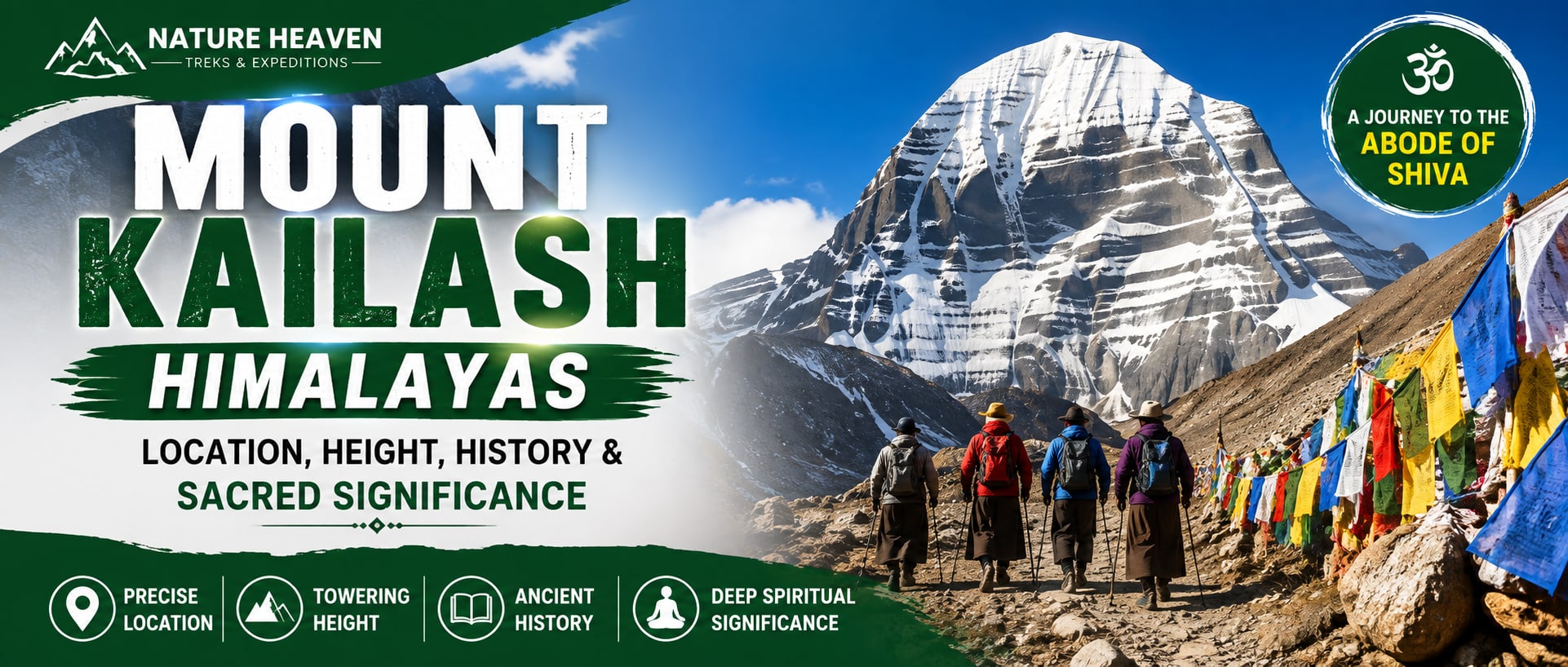
Mount Kailash Himalayas is one of the most spiritually significant peaks on Earth, located in the remote southwestern corner of Tibet. Standing at approximately 6,638 metres, it draws pilgrims and travelers from across Asia and beyond, revered simultaneously by Hindus, Buddhists, Jains, and Bon followers as a sacred axis connecting the earthly and the divine. Unlike most great Himalayan peaks, Kailash isn't famous for being climbed it's famous for never having been climbed at all. This guide covers exactly where Mount Kailash is, how high it stands, why it holds such deep religious weight, what the Kailash Kora involves, and what you need to know if you're planning to visit.

Where Is Mount Kailash Located?
Mount Kailash sits in the far southwest of Tibet, within the Kailash Range (also called the Gangdise Range), part of the wider Trans-Himalayan system rather than the main Himalayan chain itself. It lies close to where the borders of Tibet, India, and Nepal converge, though the mountain itself is well inside Chinese-administered Tibetan territory.
Is Mount Kailash in Nepal?
No , Mount Kailash is not located in Nepal. This is one of the most common misconceptions travelers have, and it's worth clearing up directly: the mountain sits inside Tibet, roughly 100+ kilometres from the nearest Nepal border crossing. The confusion largely comes from Nepal's role as a major gateway for the journey many Kailash Mansarovar tours begin in Kathmandu, travel overland through the Gyirong border crossing, and continue into Tibet from there. So while Nepal is often part of the journey to Kailash, it is not part of the mountain's actual location.
Where Is Mount Kailash on the Map?
Picture a rough triangle: Tibet to the north and east, Nepal directly south, and India's Uttarakhand region to the southwest. Mount Kailash sits near the top of that triangle, with Lake Manasarovar just to its southeast. The surrounding terrain is high-altitude plateau remote, arid, and largely unpopulated, which adds to both the physical challenge and the spiritual atmosphere of visiting.
How High Is Mount Kailash?
Mount Kailash rises to approximately 6,638 metres (21,778 feet) above sea level. That places it firmly within the Trans-Himalayan high-altitude zone, though it's far from the tallest peak in the broader region.
 Mount Kailash Himalayas
Mount Kailash vs Mount Everest
Feature | Mount Kailash | Mount Everest |
|---|---|---|
Elevation | ~6,638 m | 8,848.86 m |
Location | Tibet | Nepal/Tibet border |
Religious significance | Extremely high | Significant but different |
Climbing | Not traditionally climbed | Frequently attempted |
Altitude matters here for a practical reason too: even without climbing to the summit, visitors undertaking the Kora around Kailash's base are still operating at extreme elevation, which brings real risk of altitude sickness and demands proper acclimatisation.
Why Is Mount Kailash Sacred?
This is the heart of what makes Kailash unlike almost any other mountain on Earth — its sanctity spans four distinct religious traditions, each with its own reasons for revering the peak.
Mount Kailash in Hinduism
In Hindu belief, Mount Kailash is the eternal abode of Lord Shiva. Ancient texts describe Shiva residing at the summit in perpetual meditation, accompanied by his consort Parvati. For Hindu pilgrims, Kailash represents one of the most sacred destinations in the entire faith — a place to seek blessings, meditate, and feel closer to the divine.
Mount Kailash in Buddhism
Tibetan Buddhism identifies Mount Kailash with Mount Meru, the mythical cosmic mountain believed to sit at the exact center of the universe in Buddhist cosmology. This isn't a minor association — it positions Kailash as one of the holiest sites in the Buddhist world, a place where the physical and spiritual realms are said to intersect.
Mount Kailash in Jainism
Jain tradition holds that Rishabhadeva, the first Tirthankara (spiritual teacher) of Jainism, attained liberation at Mount Kailash. This makes the mountain a site of profound significance in the Jain path toward enlightenment, tying it directly to the tradition's ultimate spiritual goal.
Mount Kailash in Bon
Bon, the ancient pre-Buddhist religion of Tibet, regards Kailash as the seat of all spiritual power — the origin point of its religious teachings. Bon practitioners walk the Kora counterclockwise, distinct from the clockwise tradition followed by Hindus and Buddhists, reflecting their own independent spiritual framework.
Why Is Mount Kailash So Special?
Beyond the religious weight it carries, several factors combine to make Kailash genuinely unique: its distinctive, near-symmetrical shape unlike any neighboring peak; its remote, isolated position with no rival mountains nearby; centuries of unbroken pilgrimage tradition; the surrounding lakes and rivers that add ecological and cultural importance; and the restricted, respected tradition of never climbing it. Few places combine geography, religion, and mystery this completely.
Can You Climb Mount Kailash?
Mount Kailash has never been officially or successfully climbed, and this isn't a matter of technical difficulty its height and terrain are well within the capability of experienced mountaineers. It's a matter of deep, cross-religious respect. Attempting to climb the summit is widely viewed as a violation of the mountain's sacred status, and in 2001, Chinese authorities formally banned climbing attempts on Kailash, reinforcing what had already been a strongly observed taboo.
It's important to distinguish between climbing Kailash and walking the Kora around it. The Kora the pilgrimage circuit around the mountain's base is not only permitted but is the central spiritual activity associated with Kailash. Climbing the summit and walking the Kora are entirely different undertakings.
Why Has No One Climbed Mount Kailash?
Several factors combine here: deeply held religious beliefs across four traditions that regard the summit as off-limits; strong cultural respect for those beliefs, even among secular visitors and mountaineers; genuinely difficult terrain and unpredictable weather; the physiological challenges of high altitude; the mountain's remote, hard-to-access environment; and, since 2001, formal restrictions from Chinese authorities. Various legends claim earlier climbing attempts ended in failure or tragedy these stories circulate widely, but they're best treated as part of the mountain's mythology rather than confirmed historical record.
What Is the Mount Kailash Kora?
A Kora is a ritual circumambulation walking a full circuit around a sacred site as an act of devotion. At Mount Kailash, the Kora involves walking clockwise (or counterclockwise, for Bon followers) around the entire base of the mountain, passing through dramatic high-altitude valleys and past several important monasteries along the way.
How Long Is the Kailash Kora?
The Kora covers roughly 52 kilometres (about 32 miles). Given the altitude much of the route sits above 5,000 metres, with a high pass exceeding 5,600 metres this is a physically demanding trek even though the distance alone isn't extreme.
How Long Does the Kailash Kora Take?
Most pilgrims and trekkers complete the Kora in two to three days. Timing depends on individual fitness, acclimatisation status, weather conditions on the day, and which specific route and stops are chosen. Attempting it too quickly, without proper acclimatisation, significantly increases the risk of altitude sickness.
What Do Pilgrims See During the Kora?
The route offers dramatic close-up views of Kailash's shifting faces as you circle it, along with high-altitude valleys, several important monasteries positioned along the circuit, fluttering prayer flags at key points, and a steady stream of fellow pilgrims — some walking, some prostrating their way around the entire circuit as an even deeper act of devotion.
Lake Manasarovar and Mount Kailash
Lake Manasarovar sits near the base of Mount Kailash and is considered one of the most sacred bodies of water in both Hinduism and Buddhism. Many pilgrims combine their Kailash Kora with a visit to the lake, often bathing in its waters as an additional purification ritual. Surrounded by high-altitude plateau and framed by views of Kailash itself, Manasarovar adds a serene counterpoint to the more physically demanding trek around the mountain.
Mount Kailash and Lake Rakshastal
Nearby lies Lake Rakshastal, a saltwater lake that contrasts sharply with Manasarovar both visually and symbolically. Local tradition often frames the two lakes as representing opposing forces light and shadow, purity and its counterpart and many visitors choose to view both during their time in the region.
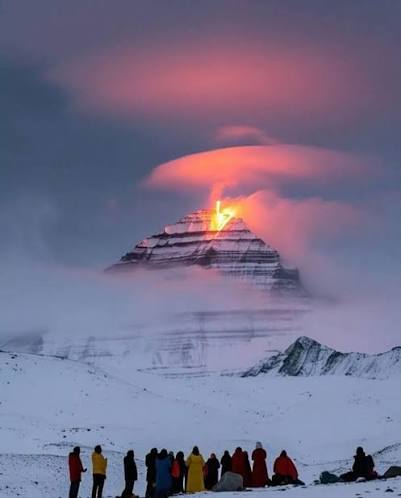 Mount Kailash Himalayas
Rivers Associated With the Mount Kailash Region
The wider Kailash region serves as the source area for four of Asia's major river systems: the Indus, the Sutlej, the Brahmaputra (known as the Yarlung Tsangpo in Tibet), and the Karnali. These rivers flow outward from the region into Tibet, India, Pakistan, Bangladesh, and Nepal, sustaining millions of people across the continent giving Kailash a practical, ecological significance that extends far beyond its spiritual reputation.
Best Time to Visit Mount Kailash
Summer
Summer (roughly May through August) is generally the most accessible period, with more stable road conditions and the highest volume of pilgrimage activity. Weather is comparatively milder, though high-altitude conditions can still shift quickly.
Monsoon Considerations
Monsoon season can affect travel routes, particularly on the Nepal side where overland roads may be more vulnerable to landslides and flooding. If you're routing through Nepal, it's worth building flexibility into your itinerary during this period.
Autumn
Autumn (roughly September through October) is often considered ideal generally favourable weather, clearer mountain views, and cooler but more stable temperatures. As with any high-altitude destination, conditions can still change rapidly, so flexibility and proper preparation matter regardless of season.
How to Travel to Mount Kailash
Via Nepal
Many travelers use Nepal as their starting point, flying into Kathmandu before continuing overland toward the Tibet border. This route typically involves crossing at Gyirong and continuing by road toward the Kailash region, combining regional logistics with the cultural experience of Nepal itself.
Via Tibet
Direct travel through Tibet typically flying into Lhasa first is the other primary route. This path requires the appropriate travel permissions and arranged logistics, since independent travel in Tibet is tightly regulated. Regulations, permit requirements, and entry conditions can and do change, so it's essential to verify current requirements directly with a licensed operator before finalising any travel plans.
Is Mount Kailash Difficult to Visit?
Visiting Mount Kailash is genuinely demanding, and it's worth going in with realistic expectations. High altitude throughout the journey, a remote location far from major infrastructure, long overland travel times, unpredictable weather, physically challenging walking conditions during the Kora, the need for proper acclimatisation, and permit and logistics requirements all combine to make this a significantly more involved undertaking than a typical low-altitude sightseeing trip. It rewards preparation and respect for the conditions.
Mount Kailash Travel and Altitude
Altitude is one of the most important practical considerations for anyone visiting Kailash. Proper acclimatisation building in rest days and avoiding rapid ascent matters more than fitness level alone. Walking at a slower pace than you might at lower elevations, staying well hydrated, and knowing how to recognise early symptoms of altitude sickness (headache, nausea, dizziness, unusual fatigue) can make a significant difference to how the trip goes. Traveling with an experienced local guide or established operator familiar with the region is strongly recommended, and anyone with individual health concerns should seek professional medical advice before undertaking high-altitude travel.
Interesting Facts About Mount Kailash
- Mount Kailash is located in Tibet, not Nepal.
- It stands at approximately 6,638 metres (21,778 feet).
- It's sacred to four major religions: Hinduism, Buddhism, Jainism, and Bon.
- The Kailash Kora is the central pilgrimage activity associated with the mountain.
- Lake Manasarovar sits nearby and is considered highly sacred in its own right.
- The wider region is the source of four major Asian river systems.
- It is not the highest mountain in the Himalayan or Trans-Himalayan region.
- Its distinctive, near-symmetrical shape has led to popular (though unverified) comparisons to a pyramid.
- Mount Kailash has never been officially climbed.
- The region draws pilgrims and travelers from across Asia and around the world.
Frequently Asked Questions
Where is Mount Kailash located?
In the far southwest of Tibet, within the Kailash Range.
Is Mount Kailash in Nepal?
No. It's located in Tibet, though Nepal is often used as a starting point or transit route for the journey there.
How high is Mount Kailash?
Approximately 6,638 metres (21,778 feet).
Why is Mount Kailash sacred?
It holds deep religious significance across Hinduism, Buddhism, Jainism, and Bon — each tradition associates it with a different, profound spiritual meaning.
Can tourists visit Mount Kailash?
Yes, with appropriate permits and arranged logistics, tourists can visit the region and undertake the Kora around the mountain's base.
Can you climb Mount Kailash?
No , climbing is both a strongly respected religious taboo and, since 2001, formally banned by Chinese authorities.
Why has Mount Kailash never been climbed?Primarily out of religious and cultural respect across four traditions, reinforced by an official climbing ban, alongside the genuine challenges of altitude, terrain, and remoteness.
What is the Mount Kailash Kora?
A ritual circumambulation a walking circuit around the base of the mountain — considered the central pilgrimage activity associated with Kailash.
How long is the Kailash Kora?
Approximately 52 kilometres, typically completed over two to three days.
Is Mount Kailash higher than Mount Everest?
No. Kailash stands at roughly 6,638 metres, while Everest reaches 8,848.86 metres.
What is near Mount Kailash?
Lake Manasarovar and Lake Rakshastal both lie close to the mountain.
What rivers originate near Mount Kailash?
The Indus, Sutlej, Brahmaputra (Yarlung Tsangpo), and Karnali all originate in the wider region.
Plan your trek
Want to Plan Your Holiday in Nepal?
Tell us your dates and fitness level. A local expert replies within a day with a private itinerary and price.
Conclusion
Mount Kailash Himalayas sits firmly in Tibet not Nepal, despite the common confusion rising to roughly 6,638 metres in one of the most remote corners of the Trans-Himalayan landscape. Its significance has little to do with its height and everything to do with what it represents: a mountain held sacred by four separate religious traditions, never climbed out of deep and enduring respect, and encircled instead by the Kora, the pilgrimage walk that remains the mountain's true purpose for visitors. Anyone planning the journey should approach it with the same respect that has kept its summit untouched for centuries and with the practical preparation that high-altitude travel genuinely demands.