


The best viewpoints in the Annapurna region aren't just about the highest point you can reach they're about which view actually fits the time and fitness you've got. This guide breaks down 11 of the region's standout viewpoints, compares them side by side on difficulty and crowd level, and unlike most trip pages tells you honestly what happens when the weather doesn't cooperate and what gear survives the cold at altitude. Whether you've got 4 days or 3 weeks, this is built to help you pick the right view, not just the most famous one.
What Makes the Annapurna Region Different From Everest for Viewpoints
Ask ten trekkers why they chose Annapurna over Everest and most will say the same thing: variety in a shorter window. You can go from a 2,000m village viewpoint at Ghandruk to a 5,416m mountain pass at Thorong La without leaving one conservation area, nature adventure and most of the classic viewpoints are reachable in treks ranging from 4 days to 3 weeks nothing here demands the minimum 12-day commitment Everest Base Camp does.
That range matters more than it sounds. A first-time trekker with 5 days can still get a genuine Himalayan sunrise from Poon Hill. A photographer with 2 weeks can chase five or six distinct viewpoints across different elevations and moods forested ridgelines, glacial lakes, high mountain passes all in one trip.
The other thing Annapurna does that Everest doesn't as much: cultural viewpoints. Ghandruk and Upper Pisang aren't just about the mountain backdrop they're about traditional Gurung stone houses and terraced fields framed against snow peaks. If you only want raw alpine scale, Everest wins. If you want variety, Annapurna does.
The Best Viewpoints in the Annapurna Region, Compared
Most guides describe each viewpoint one by one and let you piece together the comparison yourself. Here's the shortcut:
Viewpoint | Elevation | Walk from nearest teahouse | Difficulty (1–5) | Crowd level | Best season |
|---|---|---|---|---|---|
Poon Hill | 3,210m | 45–60 min pre-dawn | 2 | Very high | Oct–Nov, Mar–Apr |
Ghandruk | 2,000m | On village terrace | 1 | Moderate | Year-round |
Mardi Himal Viewpoint | 4,500m | 3–4 hrs from base camp | 4 | Low | Oct–Nov, Mar–Apr |
Khopra Ridge | 3,660m | Short ridge walk from lodge | 3 | Low | Oct–Nov, Mar–May |
Muldai Viewpoint | 3,637m | 1 hr detour from Dobato | 2 | Very low | Oct–Nov, Mar–Apr |
Annapurna Base Camp | 4,130m | Endpoint of trek | 4 | High | Oct–Nov, Mar–Apr |
Tilicho Lake | 4,919m | 5–6 hrs from Manang | 5 | Moderate | May–Oct |
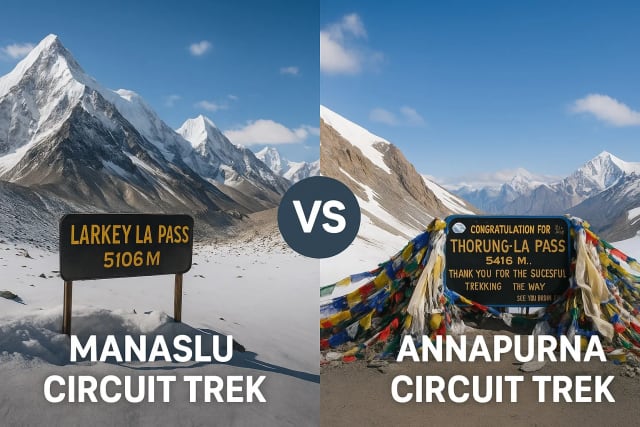
Thorong La Pass | 5,416m | Full trekking day | 5 | High (Circuit route) | Oct–Nov, Apr–May |
Muktinath | 3,710m | On-site | 1 | High | Year-round |
Which Viewpoint Fits Your Trip?
3–5 days: Poon Hill and Ghandruk, via the Poon Hill Trek. This combination gets you a genuine sunrise-over-the-Himalayas moment and a cultural village viewpoint without needing more than moderate fitness.
7–10 days: Mardi Himal, Khopra Ridge, or Annapurna Base Camp. Each of these is achievable as a standalone trek in this window, and each delivers a distinctly different feel Mardi Himal for close-up views of Machhapuchhre, Khopra for solitude, ABC for the amphitheater effect of standing inside the Annapurna Sanctuary.
14+ days: This is where the Annapurna Circuit opens up Thorong La Pass, Tilicho Lake, and Muktinath, plus most of the shorter viewpoints along the way. If you have the time, this is genuinely the most varied single trekking route in Nepal for viewpoints.
If you're stuck between two options in the same time bracket, the tiebreaker is usually crowd tolerance. Poon Hill delivers a spectacular view but you'll share it with fifty other trekkers most mornings in peak season. Muldai Viewpoint, a short detour off the Khopra route, gives you nearly the same panorama with almost nobody else there.
Annapurna weather conditions
Poon Hill's sunrise view isn't guaranteed, even in peak season. Cloud cover rolling in from the south is common enough that experienced guides build in flexibility some operators will wake you an hour earlier if the sky looks unusually clear, or suggest a second attempt the following morning if your itinerary allows it.
Higher viewpoints like Thorong La Pass and Tilicho Lake are more weather-dependent, not less wind and snow can close trails entirely for a day or two in shoulder season. If your itinerary has zero buffer days, you're gambling on a single shot at the view.
What actually helps: ask your operator directly whether their itinerary includes buffer days for exactly this. A guide who says "we build in one contingency day around the pass crossing" is telling you they've dealt with this before. One who promises guaranteed views regardless of weather is telling you they haven't.
Photography Gear That Actually Matters at Altitude
Generic packing lists tell you to "bring extra batteries." Here's what that actually means in practice: lithium batteries lose charge fast in sub-zero temperatures, so keep spares in an inner jacket pocket, close to body heat, not in your camera bag. A battery that reads 20% in your pack can show close to 60% once it warms back up.
The other thing nobody mentions: condensation. Coming down from a cold viewpoint like Kalapatthar-style elevations into a warmer teahouse fogs up your lens and camera body fast. Let your gear acclimate inside a sealed bag for 20–30 minutes before opening it, rather than exposing it to the warm air directly.
If you're trekking without a dedicated travel guide carrying your gear separately, distribute weight a full camera bag on your front and a daypack on your back is more sustainable over 6–7 hour trekking days than one overloaded bag on your shoulders.
How to reach Annapurna viewpoints
Poon Hill (3,210m)
The most accessible sunrise viewpoint in the region, reached via the Poon Hill Trek. Dhaulagiri, Annapurna South, and Machhapuchhre all light up in sequence at dawn. Expect company this is the busiest viewpoint on the list.
Annapurna Base Camp (4,130m)
The endpoint of the Annapurna Base Camp Trek, and the only viewpoint on this list where you're fully surrounded by peaks rather than looking at them from a distance. Annapurna I towers directly above; Hiunchuli, Machhapuchhre, and Gangapurna ring the rest of the amphitheater.
Khopra Ridge (3,660m)
Quieter than Poon Hill, reached via the Khopra Ridge Trek, with views of Dhaulagiri, Nilgiri, and Annapurna South from an open, uncrowded ridge.
Mardi Himal Viewpoint (4,500m)
The closest you'll get to Machhapuchhre's jagged summit without technical climbing, via the Mardi Himal Trek.. The steep final push to the upper viewpoint is the hardest few hours on this list relative to elevation gained.
Muldai Viewpoint (3,637m)
A short detour off the Khopra route that trades a bit of altitude for near-total solitude same mountain range, a fraction of the visitors.
Ghandruk (2,000m)
Less about elevation, more about the combination of Gurung village architecture and mountain backdrop. A good add-on to any Poon Hill itinerary.
Tilicho Lake (4,919m)
One of the highest lakes in the world, reached as part of the Annapurna Circuit Trek, with the turquoise water reflecting Tilicho Peak and the surrounding glaciers.
Thorong La Pass (5,416m)
The highest point most trekkers will ever stand on foot. Genuinely demanding, and genuinely the most rewarding single view on this entire list if the weather cooperates.
Muktinath (3,710m)
A pilgrimage site as much as a viewpoint, with Dhaulagiri and the Kali Gandaki Valley stretched out below a good pairing of spiritual and scenic value near the end of the Circuit.
Frequently Asked Questions
What is the best viewpoint in the Annapurna region for beginners?
Poon Hill is the most accessible moderate fitness, a short pre-dawn walk, and a well-established trail with teahouses along the way.
Which Annapurna viewpoint has the least crowds?
Muldai Viewpoint, a short detour off the Khopra Ridge route, offers similar panoramic views to Poon Hill with a fraction of the visitors.
Do I need a guide to reach these viewpoints?
For anything above Ghorepani/Poon Hill, yes routes to Khopra, Mardi Himal, and especially the Annapurna Circuit's high passes require a licensed guide under current Nepal trekking regulations.
What's the best season for photography at these viewpoints
Autumn (October–November) offers the clearest, most stable skies across nearly all of these viewpoints. Spring (March–May) is a close second, with the bonus of rhododendron blooms at lower elevations.
How much walking is involved in reaching Poon Hill?
A 45–60 minute uphill walk from Ghorepani, typically started before dawn to catch the sunrise.